
The Great Migration Tanzania Safari: A Complete Guide
 By Axel Donovan
| Update on: May 15, 2026
By Axel Donovan
| Update on: May 15, 2026
The Great Migration in Tanzania is one of the planet’s most extraordinary natural events and is often described as the greatest wildlife spectacle on Earth. Over 1.5 million wildebeests and hundreds of thousands of zebras and gazelles migrate across the Serengeti-Mara ecosystem in search of fresh grazing grounds and water every year. It is an enormous undertaking of seasonal rains and prehistoric instinct that creates spectacular predator sightings, stunning river crossings, and the safari experience of a lifetime.
To most people with an interest in wildlife, seeing the Great Migration in Tanzania is a lifetime adventure. In this guide, you will learn how the migration works with all the necessary information, how the migration process works, when it is better to visit, and where it is better to see the most incredible things.
- What is the Great Migration in Tanzania? An annual spectacle of life, death, and survival
- Why does the Great Migration in Tanzania happen?
- Great Migration route in Tanzania: Month-by-Month overview
- Best time to see the Great Migration in Tanzania
- Best places to stay for Migration viewing
- Top safari experiences to try during the Great Migration in Tanzania
- Safari tips for watching the Great Migration in Tanzania
- Great Migration in Tanzania vs. Kenya
- Conclusion
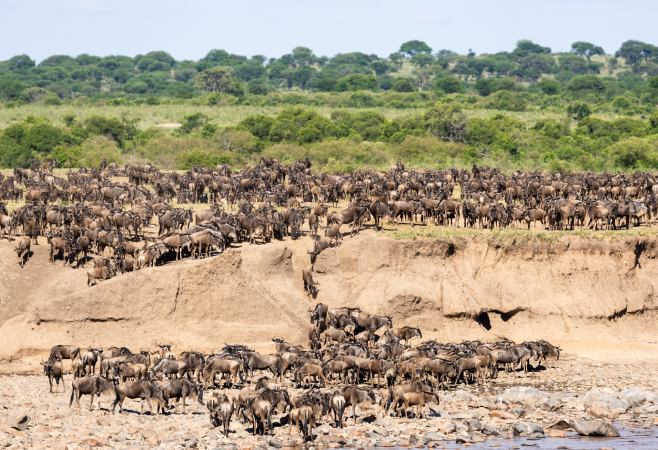
Millions of wildebeests, zebras, and gazelles move across the Serengeti plains each year during the Great Migration
What is the Great Migration in Tanzania? An annual spectacle of life, death, and survival
The Great Migration is one of the greatest wildlife phenomena on Earth, which entails the migration of more than 1.5 million wildebeests as well as hundreds of thousands of zebras, gazelles, and other grazers. These large herds undergo an annual ecological cycle across the Serengeti-Mara ecosystem every year, depending on the distribution of rainfall, in search of both grazing and water.
The migration cycle is typically observed in the southern Serengeti, where hundreds of thousands of calves are born within a few weeks, and close to half a million calves are born in a 2-3 week span. As the dry season approaches, many herds move northwest toward the Western Corridor and the Grumeti River before later heading to the northern Serengeti for the dramatic Mara River crossings. Others, like lions, hyenas, and crocodiles, hunt them down, thereby making survival even more challenging.
An eloquent example of how instinct, strength, and the fragile eco-balance characterise the Serengeti ecosystem in Tanzania is the Great Migration.
Why does the Great Migration in Tanzania happen?
The Great Migration in Tanzania is driven by ecological, climatic, and biological factors. Fundamentally, the migration is motivated by seeking new pastures and water sources. Wildebeests, zebras, and gazelles rely on the nutrient-rich grasses within the Serengeti-Mara ecosystem, and the grasses thrive following the seasonal rainfall patterns. The herds will naturally follow the change of the rains across the year.
The other major cause of the Tanzania animal migration is the calving cycle. The southern Serengeti offers ideal conditions for calving: open plains, mineral-enriched grasses, and fewer predators than in the wooded areas. Close to half a million calves are born between January and March, and this birth signifies the beginning of the first major movement as the herds pursue safer and healthier pastures.
The migration is also affected by predator-prey relationships. Large predators follow the herds, and herd behaviour is influenced by them. These, in conjunction with ancient migratory instincts over thousands of years, cause the animals to follow a more or less regular course every year with slight variations according to the amount of rainfall.
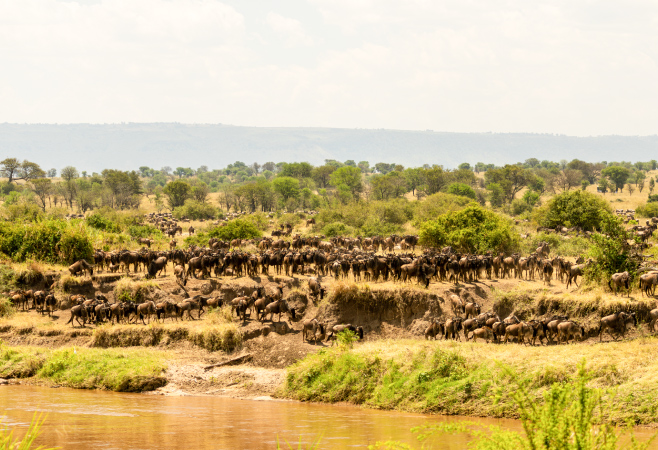
Seasonal rains drive the Great Migration across Tanzania’s Serengeti plains
Great Migration route in Tanzania: Month-by-Month overview
The Great Migration in Tanzania follows a roughly clockwise route each year, with every season offering distinct wildlife highlights. The correct annual cycle and the expectation of every stage by the travellers are as follows:
Southern Serengeti – Calving season (December-March)
It starts with the short-grass plains of the Southern Serengeti and the Ndutu region, where hundreds of thousands of wildebeests gather to give birth. Approximately 400,000 to 500,000 calves are born in a short period of a few weeks, making it one of the highest populations of wildlife in Africa.
Located in an area of green grass and good visibility, the lions, cheetahs, and hyenas prey on newborns.
This is among the most favourable seasons of extreme predator/prey encounters and a major attraction of any great Tanzania migration safari.
Central Serengeti – Herds on the move (April to June)
With the drying up of the southern plains, the herds migrate northwards to the Central Serengeti and the Seronera Valley, in particular. Long columns of wildebeests and zebras can be seen stretching across the plains in one of the most visually impressive stages of the migration.
The time has great general game viewing, high predator activity, and dramatic scenes, which are common during the animal migration in Tanzania.
Western Corridor – Grumeti river crossing (June to July)
The herds on the Western Corridor meet the Grumeti River, which is the home of some of the largest crocodiles in Africa. The Grumeti crossings are not as well-known as the Mara River but offer just as thrilling struggles for survival with fewer crowds.
The Western Corridor’s mix of woodlands and riverine forests provides a dramatic and scenic backdrop for this stage of the migration.
Northern Serengeti – Mara River crossing (July to October)
It is the most legendary stage of the Great Migration. Massive herds gather along the banks of the Mara River, spending days before they finally make the dangerous crossing.
The wildebeests and zebras are hurled into big currents and crocodile-infested waters, creating some of the most dramatic wildlife moments in all of Africa.
Return to the South (October to December)
The herds move southwards to Ndutu and the Southern Serengeti when the short rains fall. Fresh grass grows quickly, preparing the area for the next calving season.
This movement marks the completion of the migration cycle before it begins again.
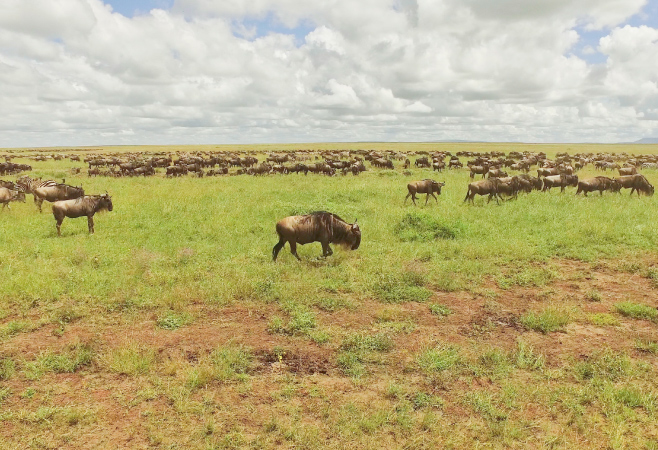
The Great Migration creates dramatic wildlife scenes across the Serengeti year-round
A family trip to Tanzania during the Great Migration offers unforgettable wildlife encounters and incredible safari memories for travelers of all ages.
Best time to see the Great Migration in Tanzania
Knowing the best time to visit helps travelers experience different stages of the Great Migration across Tanzania’s Serengeti ecosystem.
January–February: Calving Season
- Best in Southern Serengeti and Ndutu
- Thousands of wildebeest calves are born
- Excellent predator sightings and photography
July–October: Mara River Crossings
- Peak season in Northern Serengeti
- Famous wildebeest and zebra river crossings
- Dramatic and iconic wildlife moments
March–May: Green Season
- Fewer tourists and lower prices
- Lush landscapes and beautiful scenery
- Great wildlife viewing in Central Serengeti
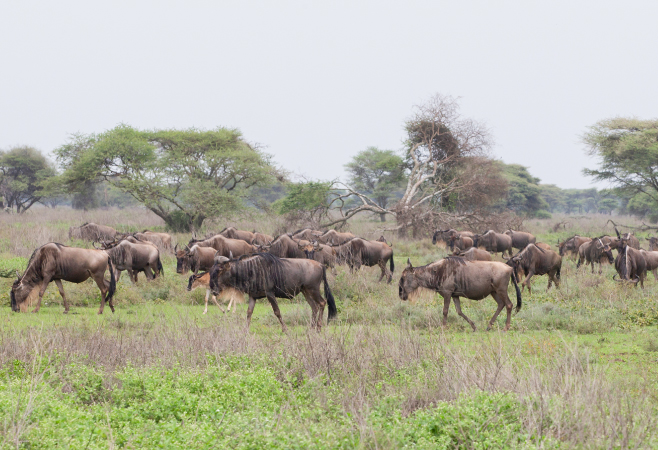
Tanzania offers migration sightings year-round, but your experience varies by season
After witnessing the Great Migration, many travelers extend their adventure with diving in Zanzibar to explore Tanzania’s colorful coral reefs and marine life.
Best places to stay for Migration viewing
Choosing the right accommodation is essential for experiencing the Great Migration at its best. Various places in the Serengeti present different viewing experiences—whether you want to witness the calving period, intense predator action, or the dramatic river crossings. The areas and types of lodges assist you in being as close to the migration herds as possible.
Ndutu (Calving Season Lodges)
Located between the Southern Serengeti and the Ngorongoro Conservation Area, Ndutu is the centre of the calving season from December to March. It is the place where hundreds of thousands of wildebeests give birth, attracting numerous predators.
Popular lodge options in Ndutu include:
- Ndutu Safari Lodge- Classic lodge with good access to wildlife.
- Lake Ndutu Luxury Tented Lodge offers spacious tented suites with modern amenities.
- Serengeti Safari Camp (Ndutu season)—a mobile safari camp that is ideally located during calving.
These Tanzania lodges are located near the short-grass plains where the herds can be found, so you do not have to drive as much and can enjoy more time watching the game.
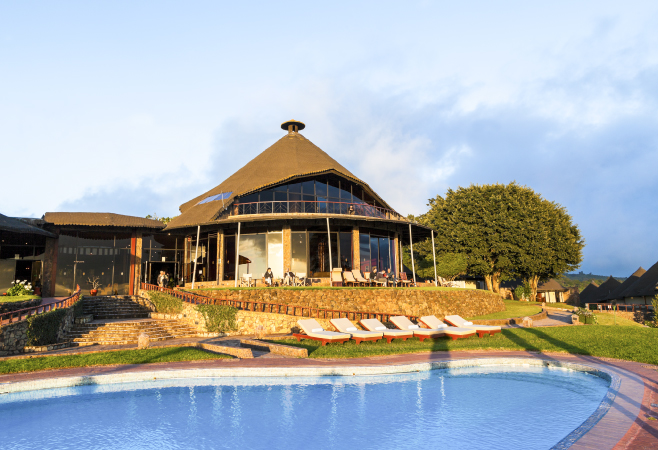
Perfect for calving season, scenic plains, and predator–prey encounters.
Seronera (Central Serengeti Lodges)
Seronera is the most reliable year-round game-viewing region in the Serengeti. From April to June and again around November, the migration herds cross this central passage.
Some of the accommodations that are recommended are:
- Four Seasons Safari Lodge – a 5-star resort with a waterhole.
- Serengeti Serena Safari Lodge – Mid-range lodge with panoramic view.
- Kubu Kubu Tented Lodge – Luxurious tents and great access to migration paths.
Seronera is also abundant in predators, which is why it is the right place to visit for a traveller who seeks to have a well-balanced safari where they can enjoy migratory sightseeing as well as meeting big cats.
Kogatende / Northern Serengeti (River Crossing Lodges)
Between July and October, the best places to experience the dramatic river crossings at the Mara are the Northern Serengeti, more so the Kogatende and Lamai regions, which are the prime locations for witnessing the dramatic Mara River crossings.
Top choices include:
- Lamai Serengeti – luxury lodge overlooking the landscape.
- Mara River Tented Lodge —near great river crossings.
- Sayari Camp – Guiding and closeness to rivers.
This remote and peaceful area offers some of the most rewarding migration experiences.
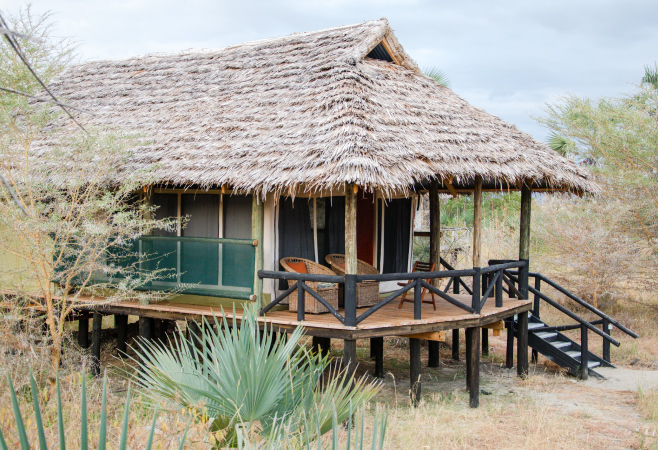
Prime location for the iconic Mara River crossings between July and October
Staying at Tanzania best safari lodges allows travelers to enjoy comfortable accommodations while experiencing the unforgettable wildlife of the Great Migration.
Mobile Tented Camps (Follow the Migration)
Mobile tented camps are ideal for travellers who want to follow the migration as closely as possible. These camps are moved multiple times every year, depending on the migration pattern.
Examples of popular mobile camps are:
- Serengeti Safari Camp (Asilia Africa)
- Serian Mobile Camp by Alex Walker.
- Serengeti Safari Camp (Nomad Tanzania)
Mobile camping offers an authentic experience of safari, very good guiding services, and a short travel time to sightseeing. They are particularly perfect for photographers and other serious wildlife lovers.
Top safari experiences to try during the Great Migration in Tanzania
A Tanzania migration safari will provide one of the most dramatic and memorable wildlife experiences on the planet. From heart-stopping river crossings to peaceful scenes of newborn calves, every phase of the wildebeest migration in the Serengeti offers a unique safari adventure for every type of traveller.
Witnessing river crossings
The Mara and Grumeti River crossings are the most memorable points of the migration. Wildebeest and zebras are also found in thousands on the banks and occasionally take hours to jump into the crocodile-infested waters. These crossings are unpredictable and emotional, and one of the key highlights of any Tanzania migration safari.
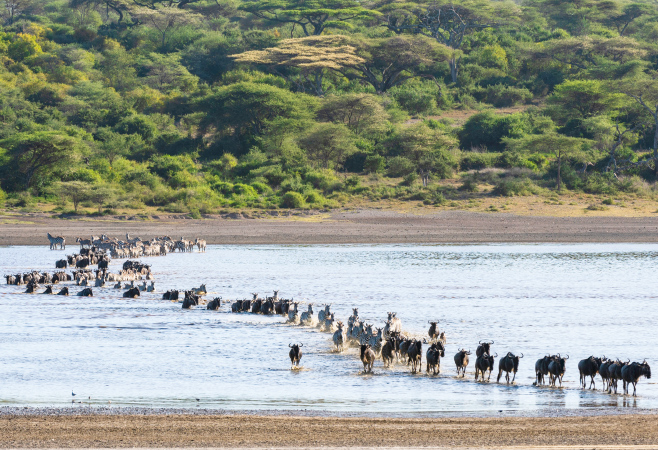
Witnessing river crossings during the Great Migration is one of the most dramatic and unforgettable safari moments
Calving season game drives
Between January and March, the Southern Serengeti is the biggest nursery of wildlife in Africa. More than 400,000 calves are born within just a few weeks, which quickly attracts predators such as lions, cheetahs, hyenas, and jackals. Game drives here showcase both tender bonding moments and dramatic predator action.
Hot air balloon safaris
A hot-air balloon safari will provide a picturesque panoramic sight of thousands of migrating animals. Balloon flights operate mainly over the Central and Northern Serengeti and finish with a champagne breakfast in the bush, which makes for a memorable experience on a migration safari in Tanzania.
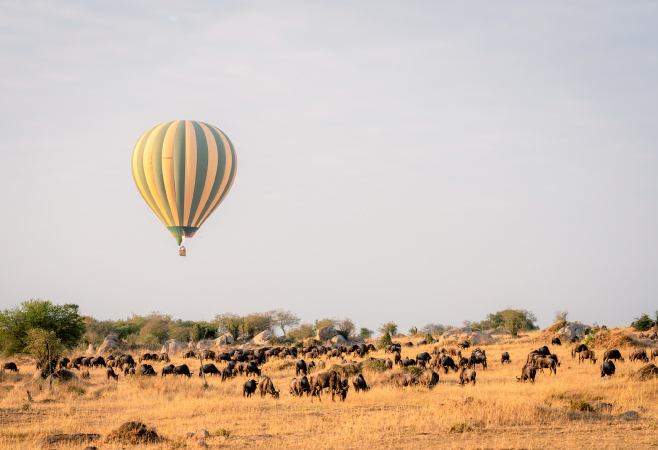
A Hot Air Balloon Safari across the Serengeti in Tanzania is a once-in-a-lifetime adventure.
Walking safaris and bush activities
Guided walks are permitted only in designated areas of the Serengeti. Walking will enable the tourists to use their senses to notice tracks, scents, sounds, and smaller creatures often missed on vehicle safaris, which they usually do not get when using vehicles. It is the perfect fit for a person who wants to be more in touch with the ecosystem.
For a closer connection to nature, many travelers choose camping sites in Tanzania to experience the Great Migration under the African night sky.
Safari tips for watching the Great Migration in Tanzania
Planning ahead helps travelers enjoy a safer, smoother, and more rewarding Great Migration safari experience in Tanzania.
- Choose the right season and safari location for calving in Southern Serengeti, river crossings in Northern Serengeti, or quieter green-season safaris.
- Book early and travel with experienced guides to secure the best lodges and improve your chances of spotting major migration events.
- Prepare suitable safari gear such as binoculars, sun protection, neutral-colored clothing, and a camera for wildlife photography.
- Be patient and respect wildlife since migration movements are unpredictable and ethical viewing helps protect the ecosystem.
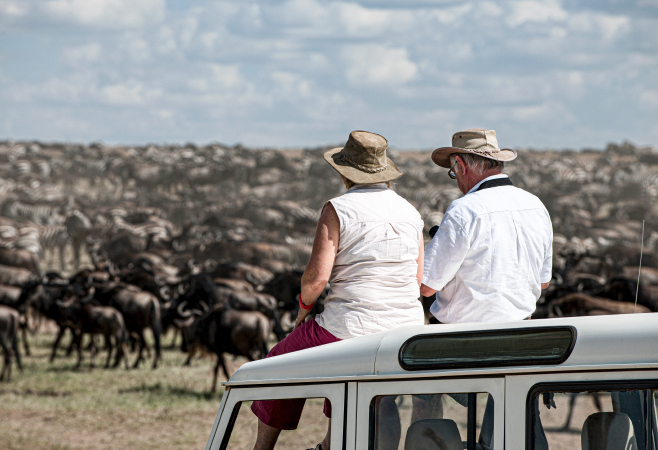
Migration hotspots—especially Northern Serengeti—fill up quickly.
Great Migration in Tanzania vs. Kenya
Both Tanzania and Kenya offer incredible Great Migration experiences, but each provides something unique.
- About 80% of the migration takes place in Tanzania’s expansive Serengeti ecosystem, providing the tourists with an extended, more diverse, and more natural wildlife experience. The Tanzanian route traverses open plains, woodlands, and river valleys, which will offer more diverse landscapes and wildlife-viewing opportunities over the year.
- Another advantage of Tanzania is that the Southern Serengeti and Ndutu region has exclusive access to the calving season—an event that does not occur in Kenya. It is also a very dramatic time in the migration (January-March), as thousands of newborn calves are present and the predators are very active.
- Instead, Kenya is exceptional for viewing the Mara River crossings from August to October thanks to the open landscapes of the Masai Mara, which make sightings easier.
Kenya is best in its high crossing season months, whereas Tanzania offers the most extensive portion of the migration cycle, from calving in the south to river crossings in the north, while Kenya provides outstanding viewing during peak Mara River crossings.
Conclusion
The Great Migration in Tanzania is one of the most incredible natural phenomena that attracts tourists and other nature lovers worldwide. The animals move from the vast plains of the Southern Serengeti in the calving season to the dramatic scenes of the crossing of the Mara River in the north, and each scene of the migration provides unique memories of survival, motion, and bare primordial nature.
The Great Migration in Tanzania is one of the most extraordinary wildlife events to witness anywhere in Africa. Whether you are a wildlife photographer, an experienced safari traveller, or a first-time visitor to Africa, the Great Migration is truly a once-in-a-lifetime experience. Plan, choose the season that matches what you want to witness, and prepare to be moved by one of nature’s most breathtaking spectacles.
Related Articles
- Zimbabwe to Tanzania Distance: Flight, Road & Travel Guide
- India to Tanzania Distance: Flight Time and Travel Guide
- Kenya to Tanzania Distance: Flight, Road Time & Travel Guide
- Affordable Tanzania Safari and Zanzibar Packages from UK
- Explore Holiday Packages from South Africa to Zanzibar
- South Africa to Tanzania Distance: Travel Routes and Essential Travel Guide
- Affordable Zanzibar Packages from South Africa
- Travel to Tanzania from Canada: Entry Requirements, Costs & Tips
- Sauti za Busara Zanzibar: Festival Guide & Tips
- Weather in Dar es Salaam: Climate Guide & Best Time

 NEED HELP 24/7
 United States
  United Kingdom
  Singapore
  Viber
Viber 


